
CollectivNews
Welcome to a monthly round-up of information relevant
to comms professionals and everyone interested in the fractional model.
December 2025

Lessons on Fractional:
Q&A with Jennifer Ferguson
Last month, we shared a Q&A with a leader who uses fractional communications support. This month, we’re flipping the lens to hear from someone in the fractional seat. Jennifer Ferguson has worked as a fractional communications executive since 2023, and CommsCollectiv partner Lisa Ryan sat down with her to get the firsthand view.
Lisa Ryan: How does the fractional model differ from your experience in traditional in-house roles?
Jennifer Ferguson: What I really appreciate about the model is both the flexibility and the opportunity for true impact and improvement. With fractional work, I’m tasked with a clear scope that I have helped craft, so I know that it’s executable and that it aligns with both my passions and strengths. With a clear remit and fewer hours to accomplish it within, there is less time to indulge the day-to-day minutiae and politics of running a function. I think the model drives a better experience, and also better outcomes in many cases.
LR: How do you build trust and influence quickly when you’re only part-time or project-based?
JF: I think curiosity, empathy and listening are key. Much like the first 90 days of onboarding in a senior leadership position, having time with the key stakeholders to understand their challenges, concerns and opportunities is incredibly important. You cannot build trust or influence if no one feels like you’re on their team. Your timeline may be accelerated, but the playbook is the same.
LR: What’s one example of a communications challenge you’ve helped solve in a fractional capacity that you couldn’t have done as effectively in a full-time role?
JF: Innovation and openness to change, whether around processes, talent and structure or strategy, can become very challenging for a full-time executive leader. Leading a team, running a function and trying to effectively collaborate with the C-suite and other executives, it’s incredibly hard to allocate time to blue-sky thinking, even when you know that’s what needs to happen. By the time a fractional is brought in, it’s typically because they know something needs to change, so they are more open to that. I’m able to come in and swiftly diagnose and solve their function’s biggest challenges without the burden of Stockholm syndrome.
LR: How has the rise of AI and automation changed the day-to-day expectations of communications leaders, fractional or otherwise?
JF: Used well, AI can be an unbelievable tool for comms teams, allowing them to create automations for the very time consuming and repetitive work of reporting and measurement, drafting and editing communications, audits and assessments of content and more. It will allow teams to use their talent for more creative and innovative endeavors and help them build solutions for implementation. It is a HUGE opportunity for Comms to really own content and have strong influence in that space. As a fractional, we have the benefit of seeing how other clients have approached and used AI across different industries. We also we have more bandwidth to help our clients to create a clear AI strategy for their teams.
LR: What advice would you give to companies considering a fractional communications leader for the first time?
JF: Strategic communications is more than just PR and media relations. It’s building reputation, growing brand affinity and awareness and mitigating risk. It’s showing up consistently, with clear messaging, where your audience and stakeholders live. It should be intentional and not transactional. Bringing in a fractional executive presents a cost-effective opportunity to leverage communications in a more holistic and effective way, especially if you have a small and/or junior team. Fractional talent is like air traffic control; we see the big picture from 35,000 feet.
On the more practical side, there are some key enablers for success. A very clear scope with agreed upon expectations, robust and honest two-way communication between the fractional executive and whomever brought them in, and access. Ensuring the fractional talent has access to the people who matter, in terms of getting as much information and buy-in as possible, will ultimately determine their success. No matter how good you are at what you do, without these three things, you will not succeed.
LR: What advice would you offer to a senior professional entering into a fractional assignment?
JF: There is a huge mindset shift from being a full-time employee who is leading a function/team to being a fractional who may or may not execute and must be surgical with their time against impact, and I think that is the hardest learning curve. After you have assessed your ability to be successful in the assignment and feel confident that what they need is something you can deliver, set clear deliverables and boundaries and focus only on those. Do not get distracted by everything you see and want to fix. It’s easy to get frustrated when you see opportunities that aren’t being leveraged, or teams that are ineffective, but you have to let that go and focus only on what you are there to do, and do that really, really well. And then go home and relax. The beauty of fractional is that you are not taking on full-time problems, just part-time opportunities.
LR: What’s the biggest misconception organizations have about bringing in a fractional communications leader and how do you dispel it?
JF: I think there are two – expense and need. If an organization hasn’t properly invested in strategic comms, they likely don’t even know what great looks like, so they aren’t sure what or if they need (it). Without a broader understanding, they may view it as too expensive, especially if they are under-invested in the function.
The reality is that they are getting that exec talent for significantly less than what a fully loaded salary would be. Not only will the fractional talent bring strategy and structure to the function, but those pieces will better enable the rest of the talent in the function to succeed, extracting more value out of that investment to exponentially increase the total ROI. I think there is a strong business case for a model of fractional comms leadership that is on-going as well as short-term.
For organizations who are looking to cut costs, instead of putting comms under marketing or HR leadership in lieu of hiring a full-time dedicated comms senior leader, they should instead consider fractional leadership. It’s amazing what 2-3 days a week of excellent fractional talent can do to improve the functions strategy and outcomes. It isn’t about time; it is about experience and impact.
LR: How do you measure success in a fractional engagement when you may not be embedded day-to-day in the organization?
JF: Success should be measured by the deliverables and their collective impact. If you have a clear scope going into the assignment with agreed upon expectations, then you have an easy way to set your own KPI’s and measure your effectiveness. Without agreed upon deliverables, it’s very hard to stay focused and measure outcomes. When you draft an engagement that is focused on the deliverables against a timeline, there is no murkiness around what you are there to do and if you are doing it well.
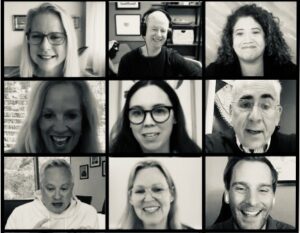
If I Only Had 10 Minutes: 9 Voices. 90 Minutes. A Year’s Worth of Wisdom
Nine guests. Nine rapid-fire conversations. More than 90-minutes of distilled wisdom from some of the sharpest minds in communications. As we close out the year, we wanted to share some of the sharpest insights from our new podcast: If I Only Had 10 Minutes.
1. AI Is a Tool. Judgment Is the Job.
No one’s sugarcoating it: AI is here, it’s powerful and it’s nowhere near enough on its own.
IBM’s Jonathan Adashek put it plainly: AI doesn’t drive the bus in a crisis. “I don’t see myself giving that over to AI completely … There are key people I deal with on those sorts of things…AI’s not going to get the final say.”
Jane Hanson, Emmy-winning journalist, sharpened the point further: AI can generate, but it can’t feel. “It can’t make you cry, and it can’t make you laugh.” In an industry built on intuition, vulnerability, and emotional precision, that gap is enormous.
Eleanor Hawkins of Axios noted another looming challenge: companies are adopting AI faster than they’re governing it. “Most companies don’t have a clear policy… and if they do, it is not well understood.” The experimentation is happening. The guardrails aren’t.
From the lens of responsible tech, Rebecca Gonzales, architect of the Responsible AI Comms Lab, offered the most familiar indictment: communicators are still brought in too late, after the code is written, after the tools are deployed, and often right before something breaks.
And then came the bluntest perspective of all: Nancy Elder cut through the debate with six words every communicator should pin above their desk: “Get on board with it… It’s here.”
Bottomline: AI is accelerating everything. But the irreplaceable parts of our work like judgment, timing, empathy, remain squarely human.
2. The Rise of “Fractional” and Why Everyone’s Talking About It
“Fractional” has gone from niche to unavoidable and for good reason. The value proposition is no longer theoretical; it’s proven.
Microsoft’s Frank Shaw highlighted the single biggest advantage: fresh perspective. “When you’re living something day-to-day, your frame is narrow… Having someone who isn’t living it, who’s not carrying the baggage, can reframe the challenge and get to better answers.”
From the CC talent pool, Brad Gorman, who has had full-time and fractional roles, put a finer point on it: “Not every company needs senior counsel in the building every day… but when something big happens… you need someone who’s been around the block… but not forever.”
Fractional isn’t a fad. It’s a structural shift, offering experience without the overhead, objectivity without politics, and expertise without delay. Companies aren’t just hiring fractional talent because it’s flexible. They’re hiring it because it works.
3. The Best Communicators Aren’t Always the Obvious Ones
Ask a room full of communicators to name the best communicator they’ve ever seen, and you’ll get presidents and philosophers, but that’s not where the most interesting answers landed.
Michael Schoenfeld of Brunswick pointed to Prince. Not for his music, but for his mastery of presence: “His ability to compel an audience… to build a whole experience… it was extraordinary.”
Desiree Fish of Roblox, not religious herself, pointed to Jesus. Not the theology, but the storytelling. “He demonstrated things, didn’t just say them… let’s show not just tell.”
Across wildly different examples, one theme cut through:
Great communicators don’t just inform. They transform. They create connection.
They make you feel something and feeling beats messaging every time.
What Tied All Nine Conversations Together? Humanity.
Whether the lesson was “pursue clarity not perfection,” “ask questions before you give answers,” or “be generous with your time,” every guest echoed the same truth:
Tools change. Expectations shift.
But communicators show up.
They ask questions.
They adapt.
They listen.
They make people feel seen.
And that, not the tech, not the titles, is the power of the work.
“If I Only Had 10 Minutes” is a weekly podcast and can be found on Spotify, Apple Podcasts, and YouTube.

Responsible AI Trends as 2025 Draws to a Close
As we wrap 2025, one thing is clear: AI only works when the systems around it keep up. Governance, oversight, transparency, and communication have to move at the same pace as the technology. Right now, the tech is sprinting, while most internal systems are still stretching before the race even starts.
Adoption is everywhere: 88% of organizations use AI, but impact is uneven. Only a third have scaled beyond pilots, and just 6% report meaningful gains. That gap isn’t about capability. It’s about responsibility. Here are the trends shaping that reality.
1. Governance Is Becoming a Living System
To do governance right, companies have to recognize that there are different regulatory challenges by country, and in the US, by state and build governance frameworks that adapt in real time, not once a year. Those who do it right document risks, track model behavior, and communicate openly about what their systems can and can’t do.
Where Comms Fits
This year, we ran our Responsible AI Comms Lab and the takeaway was clear: Communications teams have a critical role to play. We have to help translate technical risks into human language, clarify decision boundaries, build realistic expectations, and make sure employees understand how AI fits into the work they’re doing. Accountability starts with clarity.
2. Agentic AI Raises the Stakes
AI agents aren’t fringe anymore. About 23% of organizations are piloting them, and 10% have already scaled. They’re running workflows, talking to customers, and, yes, sometimes talking to other agents.
With autonomy comes a new set of questions:
- Who verifies the agent’s actions?
- How do you prevent spoofing or misalignment?
- Where is the human in the loop?
Some sectors are building standards (like verifiable identity frameworks), but this space is still evolving.
Where Comms Fits
Comms now has to help define human-in-the-loop expectations, build messaging that’s honest about limitations, and train internal teams on how to interpret AI outputs. Our participation matters. Multi-disciplinary teams continue to show fewer blind spots and fewer incidents.
3. Bias, Multimodality, and the Push for Transparency
With multimodal models powering text, audio, and video workflows, explainability is getting harder.
Companies are finally investing in bias audits, curated datasets, uncertainty detection, and energy-efficient infrastructure. Not because it’s trendy, but because customers and regulators now expect transparency as the baseline.
Where Comms Fits
Open dialogue is becoming the core strategy. Clear explanations of data sources, safeguards, and limitations build trust faster than any marketing campaign. And proactive communication around risk is becoming a differentiator, not a burden.
4. Workforce and Society Are Shifting
Automation is reshaping junior roles. Scientific research is accelerating. Global institutions are scrambling to align on guardrails. And the AI-crypto intersection (agentic commerce, verifiable compute, distributed intelligence) is picking up speed faster than most people expected.
Where Comms Fits
Comms teams shape how organizations talk about change. Explaining strategy, setting expectations, and grounding teams in reality helps reduce fear and improve adoption. Implementation takes hold when people understand the “why” and the “how.”
Looking Ahead
Responsible AI is no longer optional. It’s the difference between AI that drives value and AI that drives headlines. And with less federal oversight than before, organizations have to build their own guardrails, fast.
For communications leaders, the path is clear: Lead with ethics. Explain with precision. Build transparency into the culture, not the crisis plan.
And if you want to go deeper, our next Responsible AI Comms Lab cohort begins in February.