
CollectivNews
Welcome to a monthly round-up of information relevant
to comms professionals and everyone interested in the fractional model.
July 2026
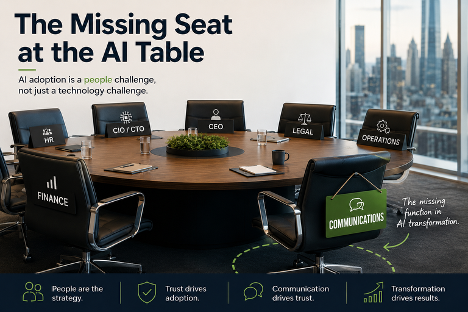
The Missing Seat at the AI Table is Comms
Communications teams are used to being brought in after a strategy is developed.
The plan is set, the decisions have been made, and the tools have been selected. Communications’ job is to explain the change.
In the AI era, that approach is becoming increasingly risky.
As organizations race to deploy AI, many are treating it primarily as a technology initiative. The focus is on models, agents, automation, software licenses, and productivity gains. Yet some of the biggest challenges companies are facing have little to do with technology itself.
They’re human challenges: Trust, adoption, job redesign, culture, leadership and communication.
In a recent Bloomberg interview with Anthropic CEO Dario Amodei, he expressed skepticism about retraining as a solution to AI-driven workforce disruption. It’s a fair concern. AI is moving quickly, and many workers will need new skills. But I wonder if we’re framing the problem incorrectly.
The issue may not be that retraining doesn’t work. The issue may be that organizations have not invested enough in the conditions that make retraining successful.
Consider a striking statistic recently highlighted by Deloitte CTO Bill Briggs: companies are spending approximately 93% of their AI investments on technology and only 7% on people.
Organizations are investing heavily in the tools while underinvesting in the workforce expected to adopt them. They are concentrating on implementation and measuring deployment while neglecting comprehension and trust.
Briggs described it as focusing on the ingredients instead of the recipe.
And that’s where communications comes in.
Successful AI transformation isn’t just about introducing new technology. It’s about helping people understand why change is happening, how it affects their work, what opportunities it creates, and what support will be available along the way.
Without those answers, uncertainty fills the gap,and uncertainty rarely drives adoption. We’re already seeing signs of this disconnect.
Deloitte research found that employee trust in generative AI has declined even as access to AI tools has increased. At the same time, “shadow AI” continues to grow, with employees using unapproved tools because they perceive them as easier, faster, or more effective than the solutions provided by their employers.
Meta CTO Andrew Bosworth acknowledged that the company’s rollout of its Applied AI organization was, in his words, “atrocious.” Employees reported confusion, uncertainty about career paths, and concerns that their expertise was no longer valued.
Notably, Bosworth’s criticism wasn’t focused on the technology. It was focused on communication. He admitted that leadership failed to clearly explain the vision, help employees understand the changes, and show them how they fit into the future organization.
This is not just Meta’s failure.Stories like this are becoming common across industries as organizations move faster than their employees can absorb.
Communications professionals understand how people process uncertainty. They understand trust, engagement, behavior change, and organizational culture. Those skills are increasingly critical as companies rethink jobs, workflows, and operating models.
That’s why communications leaders can’t be seen simply as translators of AI strategy. They need to help co-create it.
The most successful organizations will likely be those that resist the urge to deploy AI everywhere and instead focus on where it can deliver meaningful impact.
That requires more than technology leadership. It requires cross-functional leadership.
HR needs a seat at the table.
Operations needs a seat at the table.
Legal needs a seat at the table.
And, Communications needs a seat at the table.
Comms leaders need a practical understanding of where AI creates value, where human judgment remains essential, and how to marshal AI adoption inside their organizations.
Because the future of work will not be determined solely by what AI can do. It will be determined by how effectively organizations help people adapt, trust, and thrive alongside it.

The Grind Is Optional Now, But Most PR Pros Don’t Know That.
By Chris Gee, AI Strategist
Eighty percent of companies that cut staff to fund AI saw no improvement in returns.
That’s not a hot take from an AI skeptic, that’s Gartner, surveying 350 global executives at companies with more than a billion dollars in revenue.
The organizations that got ahead didn’t reduce headcount. They gave their people capabilities they didn’t have before.
Here’s why that should matter to everyone reading this newsletter: the same logic applies to your practice. Cutting time isn’t the move. Cutting the right work is.
There is a specific category of work in communications that is high-volume, lower-stakes, and consuming a disproportionate share of your best hours. Not low-priority work, but work that shouldn’t take as long as it does. That’s what AI agents were built for.
Most Comms Leaders Are Asking the Wrong Question
When AI first surfaced in our industry, the question was: “Will AI replace communicators?” That was the wrong question, and most of us knew it. Strategy, relationships, judgment, narrative: none of that is automate-able, and it’s still where the real value lives.
But there’s a follow-up question that’s more important: “Are you spending your time on those things, or are you still doing the work AI could handle?”
For most agency owners, in-house leaders, and independent consultants I talk to, the honest answer is both. The administrative grind hasn’t gone away. It’s sitting alongside everything else, consuming hours that should be going to the work only they can do.
Nobody’s falling behind because they’re anti-AI. They’re falling behind because they haven’t stopped long enough to figure out which part of their work to hand off first.
What’s at Stake
An agency principal I know tracks three client accounts. She told me she spends four to six hours a week on monitoring and briefing prep alone, work she knows could be automated, work she hasn’t automated because there’s no window in the delivery schedule to stop and figure it out. She hasn’t fixed it because delivery doesn’t leave room to stop and redesign how you work. That’s the trap.
In-house leaders are fielding the same pressure (“what’s our AI ROI?”) from their C-suites while their teams are still doing that work manually. Consultants are losing work to people who figured out how to produce in two hours what used to take eight.
The Opportunity
The work that’s automatable is also the work that’s been eating your margin, or your time, which is the same thing if you’re billing hours.
The frame I keep coming back to: what to automate, what to protect. The grind gets automated. The human touch (the relationships, the judgment, the counsel that no AI can replicate) is what you protect. And when you’re not spending your best hours on the grind, you can actually deliver on it.
Automate the grind, own the strategy. The comms pros who do that first will be the ones setting prices, not defending them.
Where to Start
CommsCollectiv Partner, Monica Talan, and I are running a one-day workshop on July 25 for PR and communications professionals who want to stop talking about AI agents and start using them. Agency leaders, in-house comms directors, independent consultants, anyone who is good at their work and wants more of their hours back.
In four hours you’ll build AI workflows mapped to the work that’s been eating your hours. You’ll leave with a personal AI stack and a 30-day plan. Think co-pilot, not autopilot: everything is prompt-based and you’re in control. If you can write a briefing, you can build this.
The workshop is on Maven. The date is July 25. Registration is $650.
If the honest answer to “am I spending my hours on the right work?” is uncomfortable, this is the room to be in.

Fractional Comms Leadership is Coming of Age, but It’s Not Like Other Fractional Roles
Fractional leadership is no longer an emerging trend. It has become an accepted business strategy.
Recent research suggests that approximately one-quarter of U.S. companies now utilize some form of fractional executive leadership, with organizations increasingly engaging experienced CFOs, CMOs, CHROs, CIOs and other C-suite talent on a part-time or project basis. The appeal is clear: access to seasoned executive expertise without the cost or long-term commitment of a full-time hire.
Communications is beginning to follow that same trajectory, but it hasn’t yet reached the level of acceptance enjoyed by other executive functions.
While fractional CFOs and fractional CMOs have become increasingly common, many organizations are still unfamiliar with the concept of engaging a fractional executive. Some continue to view communications through the traditional lens of agencies, project work or media relations, rather than as a strategic leadership function that deserves a permanent seat at the executive table, even if that seat isn’t full-time.
That is beginning to change.
Across the U.S. and abroad, more organizations are hiring fractional communications executives to lead reputation management, executive communications, crisis preparedness, media relations, internal communications and strategic positioning. Companies increasingly recognize that they need experienced communications judgment, but not necessarily a full-time communications executive.
As the model gains acceptance, however, one important distinction is often overlooked: Communications leadership is fundamentally different from many other fractional executive roles.
A fractional CFO can quickly analyze financial statements, model cash flow or evaluate capital structures. A fractional technology leader can assess systems and infrastructure. Those disciplines certainly benefit from relationships and institutional knowledge, but much of the work is grounded in technical expertise that can be applied immediately.
Communications doesn’t work that way.
The most valuable communications counsel depends on trust, context and relationships. Effective communications leaders understand the organization’s history, culture, values and stakeholders. They know what commitments have already been made, what messages have resonated, where potential vulnerabilities exist and how leadership teams make decisions under pressure.
Perhaps most importantly, they earn the confidence to tell a CEO not what they want to hear, but what they need to hear.
The most successful fractional communications leaders become embedded members of the executive team. They participate in leadership meetings, build relationships across the organization, understand board dynamics and remain connected to the business between projects and crises. They are not simply outside consultants who attend occasional meetings. They become trusted advisors with both strategic perspective and operational involvement.
That distinction matters. And it may be why communications has been slower than other executive disciplines to embrace the fractional model.
As demand for experienced communications leaders continues to grow, companies are also discovering another reality: exceptional fractional communications talent remains relatively scarce. Experienced practitioners with boardroom credibility, crisis management expertise and executive communications experience are increasingly sought after. At the same time, many organizations are still learning what effective fractional communications leadership looks like and how to fully leverage it.
We believe that gap will narrow over the next several years.
Just as organizations have embraced fractional finance, marketing and technology leaders, they will increasingly recognize that communications is a strategic business function deserving of experienced executive counsel.
The future of communications leadership is undoubtedly becoming more flexible. But its success will depend less on the fractional model itself and more on how organizations implement it.
The companies that get it right won’t simply engage a fractional communications executive. They’ll integrate that executive into the team, transforming a fractional communicator into a trusted communications leader.