
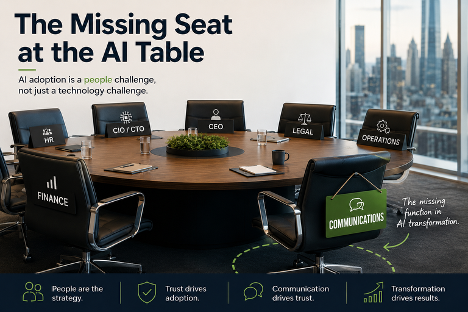
Communications teams are used to being brought in after a strategy is developed.
The plan is set, the decisions have been made, and the tools have been selected. Communications’ job is to explain the change.
In the AI era, that approach is becoming increasingly risky.
As organizations race to deploy AI, many are treating it primarily as a technology initiative. The focus is on models, agents, automation, software licenses, and productivity gains. Yet some of the biggest challenges companies are facing have little to do with technology itself.
They’re human challenges: Trust, adoption, job redesign, culture, leadership and communication.
In a recent Bloomberg interview with Anthropic CEO Dario Amodei, he expressed skepticism about retraining as a solution to AI-driven workforce disruption. It’s a fair concern. AI is moving quickly, and many workers will need new skills. But I wonder if we’re framing the problem incorrectly.
The issue may not be that retraining doesn’t work. The issue may be that organizations have not invested enough in the conditions that make retraining successful.
Consider a striking statistic recently highlighted by Deloitte CTO Bill Briggs: companies are spending approximately 93% of their AI investments on technology and only 7% on people.
Organizations are investing heavily in the tools while underinvesting in the workforce expected to adopt them. They are concentrating on implementation and measuring deployment while neglecting comprehension and trust.
Briggs described it as focusing on the ingredients instead of the recipe.
And that’s where communications comes in.
Successful AI transformation isn’t just about introducing new technology. It’s about helping people understand why change is happening, how it affects their work, what opportunities it creates, and what support will be available along the way.
Without those answers, uncertainty fills the gap,and uncertainty rarely drives adoption. We’re already seeing signs of this disconnect.
Deloitte research found that employee trust in generative AI has declined even as access to AI tools has increased. At the same time, “shadow AI” continues to grow, with employees using unapproved tools because they perceive them as easier, faster, or more effective than the solutions provided by their employers.
Meta CTO Andrew Bosworth acknowledged that the company’s rollout of its Applied AI organization was, in his words, “atrocious.” Employees reported confusion, uncertainty about career paths, and concerns that their expertise was no longer valued.
Notably, Bosworth’s criticism wasn’t focused on the technology. It was focused on communication. He admitted that leadership failed to clearly explain the vision, help employees understand the changes, and show them how they fit into the future organization.
This is not just Meta’s failure.Stories like this are becoming common across industries as organizations move faster than their employees can absorb.
Communications professionals understand how people process uncertainty. They understand trust, engagement, behavior change, and organizational culture. Those skills are increasingly critical as companies rethink jobs, workflows, and operating models.
That’s why communications leaders can’t be seen simply as translators of AI strategy. They need to help co-create it.
The most successful organizations will likely be those that resist the urge to deploy AI everywhere and instead focus on where it can deliver meaningful impact.
That requires more than technology leadership. It requires cross-functional leadership.
HR needs a seat at the table.
Operations needs a seat at the table.
Legal needs a seat at the table.
And, Communications needs a seat at the table.
Comms leaders need a practical understanding of where AI creates value, where human judgment remains essential, and how to marshal AI adoption inside their organizations.
Because the future of work will not be determined solely by what AI can do. It will be determined by how effectively organizations help people adapt, trust, and thrive alongside it.