
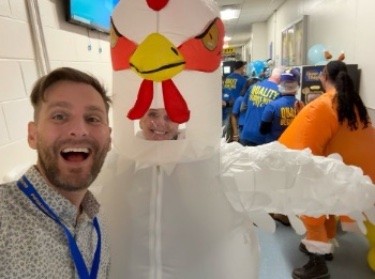
Why was I running around a manufacturing plant with a giant inflatable chicken, talking to employees in three languages about the importance of quality?
Because fractional communications work takes you places — from the C-suite to the coop.
Fractional roles are gaining traction in tech and consulting. But for the past six months, I found myself deep in America’s food supply chain — helping transform employee communications for 21,000 associates at an iconic U.S. agribusiness.
Yes, that included climbing grain elevators, holding chicks in hatcheries, and translating quality messaging with operations teams that had never worked with a comms lead before.
Unscrambling the Messaging
The company had just launched its first new quality policy since 1992. The CEO made it clear: every employee — from farmers to plant-floor associates — needed to understand how their role impacted quality.
This wasn’t just about compliance. It was about culture. For a 105-year-old brand, quality isn’t just a business imperative — it’s their promise.
But the message wasn’t landing with the people doing the work.
I thought about Daisy, a first-shift operator with 25 years of experience making chicken nuggets at a plant near me in Charlotte. How do I reach her?
Hatching a Better Plan
I started with the audience: Where are they? What do they care about? How do they communicate?
Then I built a new campaign: Quality Begins With Me — centered on real employees: their voices, their languages, their stories.
In six months, we moved from “policy on a slide” to an enterprise-wide movement, including:
— Leadership visits to plants — not just emails
— Quality Begins with Me translated across multiple languages
— Associates featured in storytelling to show ownership
— A video series, intranet articles, signage, talking points — the whole gamut
The Fractional Pecking Order
The $10B privately held AG company was looking for someone to relocate to a small town on the East Coast. After their search for an internal comms leader took longer than normal, they became more open to filling the role with fractional talent, so that’s where I came in.
With me, they got a comms lead who could jump in fast and deliver, and I got the flexibility to do meaningful work in 20 hours a week — and still live my life.
Leading fractionally means flexing fully. Sure, I wasn’t always calling the shots — I was embedded into the team, sometimes taking detailed direction, building decks, and handling tasks that felt like more junior work I hadn’t touched in over a decade. But I embraced it — because that kind of flexibility was a win/win for both the company and me.
The Takeaway
Fractional communications is a smart, strategic way to do business. For the company, it meant gaining a seasoned professional with experience writing for CEOs, transforming communications models to resonate with employees at every level, and a proven track record of helping thousands of employees see their place within a 100-year legacy of quality.
For me, fractional work offered the perfect blend of flexibility and challenge that I was seeking.
I did not need to be on staff full time to make an impact. I needed a clear strategy, a little humility…and maybe one giant inflatable chicken.
Brad Gorman is a communication executive with more than20 years of experience shaping the reputation of iconic brands like GM, Whirlpool, and KitchenAid. He now does fractional communications work — and writes bios in the third person.